
The 18650 battery voltage often causes confusion because most cells are labeled as 3.7V yet charge to 4.2V. This article immediately clarifies the difference and concludes that understanding 18650 battery voltage is essential for safe charging, correct series/parallel design, and proper device matching. The passage compares 18650 battery 4.2V vs 3.7V, explains why these two voltages exist, analyzes performance differences, answers common usage questions, and guides readers to make the right choice.

Main content:
- Are all 18650 batteries the same voltage?
- How many amps can a 18650 battery put out? What factors can affect the battery voltage?
- What is the highest output 18650 battery?
- How many volts is 2 18650 batteries? Calculating series and parallel 18650 battery voltage
- At what voltage is a 3.7 V battery dead?
- What voltage should I charge a 3.7 V lithium ion battery?
- Can I charge a 3.7 V battery with a 4.2 V charger? Matching charger with 18650 battery voltage
- Can I use a 3.7 V battery instead of 4.2 V?Understanding 18650 battery voltage compatibility
- Conclusion
You might find it challenging to differentiate between the 18650 battery 4.2V vs 3.7V, especially since both of them are lithium-ion batteries of the same type. This article provides a comprehensive analysis of the differences between the 18650 battery 4.2V vs 3.7V, aiming to help you clearly understand the differences between these two 18650 batteries with different voltages. I believe that after reading this article to the end, you will be able to make the most appropriate choice between 18650 battery 4.2V vs 3.7V. In addition, if you want to know more information about the 18650 battery store near you, please click where can I buy 18650 batteries in store on our website for details.
1.Are all 18650 batteries the same voltage?
The 18650 voltage range is typically 2.5V to 4.2V, but different chemistries may shift this range slightly. For example, NMC and NCA cells commonly operate from 2.5V to 4.2V, LCO cells run from about 2.75V to 4.2V, LiFePO₄ cells use a lower range of roughly 2.5V to 3.65V, and high-voltage variants can extend the upper limit to 4.35V or even 4.4V depending on the design.
The 18650 max voltage is typically 4.2V, which represents the full-charge level for most lithium-ion cells. The only things that are common with 18650 batteries are the dimensions - 18mm x 65mm and the fact that they are lithium-ion. Most 18650 batteries have voltages ranging from 2.5V to 4.2V. Different 18650 batteries are built with different intentions in mind. It would be best if you’d consider checking your 18650 battery’s capacity and voltage before buying. Mismatching batteries can prove to be detrimental to your devices. Always check your 18650 voltage and capacity before purchasing.
2.How many amps can a 18650 battery put out? What factors can affect the battery voltage?
18650 batteries have capacities typically between 2,500mAh and 3,500mAh. Higher capacity means the battery can power a device longer at a given current. The 18650 battery ampere rating determines the maximum current it can safely deliver. For example, a 4.2V 3,600mAh 18650 battery with a 3.6A ampere rating can theoretically provide 3.6A for one hour, or 1.8A for two hours.
a) With a 3.6A current
Time = 3.6 Ah ÷ 3.6 A = 1 hour
b) With a 1.8A current
Time = 3.6 Ah ÷ 1.8 A = 2 hours
Three primary factors affect 18650 battery voltage:
- Operating temperature- the battery voltage is related to the activity of the active material inside the battery. Therefore, the ambient temperature that affects the activity of the active material can also affect the battery voltage in a small range;
- Load power- since the voltage and power of the battery are fixed values, the greater the load power (low resistance), the greater the required current, and the corresponding voltage will be reduced to make up for the reduced power, and excessive load may cause damage to the battery;
- Battery life(or health) - One way to detect a faulty or unsafe battery is by checking its performance. When a battery is no longer safe for use, you'll notice that it does not retain its charge as it used to. That also means that its voltage drops.
Simply put, factors that affect your battery voltage are the working temperature, load power and battery life(or health).
3.What is the highest output 18650 battery?
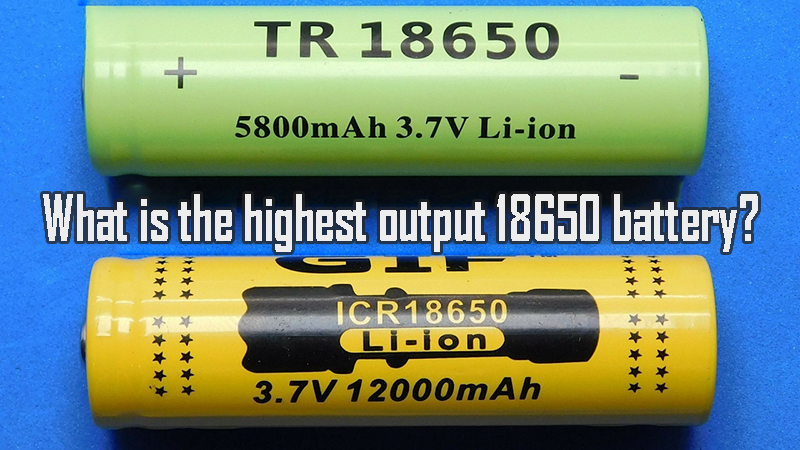
A high-performance 18650 battery can reach 3,500mAh. Better-performing cells also maintain more stable 18650 battery voltage under load. In addition, the output power of the 18650 rechargeable battery is up to 19W, the maximum output current is 7A, and the highest output voltage is about 4.2V.
4.How many volts is 2 18650 batteries? Calculating series and parallel 18650 battery voltage
The nominal voltage of the 18650 battery voltage is 3.7V, and the battery pack voltage when 2 18650 batteries are connected in series is 7.4 volts. The max charge voltage of the 18650 battery is 4.2V, and the maximum voltage can reach 8.4 volts(4.2V x 2) when two 18650 batteries are connected in series. These batteries have to be connected in series. You'll need to connect three 3.7V 18650 in a series to get a nominal voltage of 12V. It is important to note that connecting your batteries in series does not increase the capacity of your battery pack but will increase its voltage. On the other hand, connecting your battery in parallel does not increase your battery voltage but will increase its capacity.
5.At what voltage is a 3.7 V battery dead?
When the voltage of the 3.7 V 18650 battery drops to 3V, it will be dead. This is because the protection board stops discharging to prevent the battery from being overdischarged. The cutoff 18650 voltage of a cell is 2.75V. Under normal circumstances, when the battery voltage drops to 0.875 times the nominal voltage (3.24 V), it should be charged in time. On the other hand, a 18650 battery with a 4.2V can be considered dead when its voltage reaches 3.0V as well.
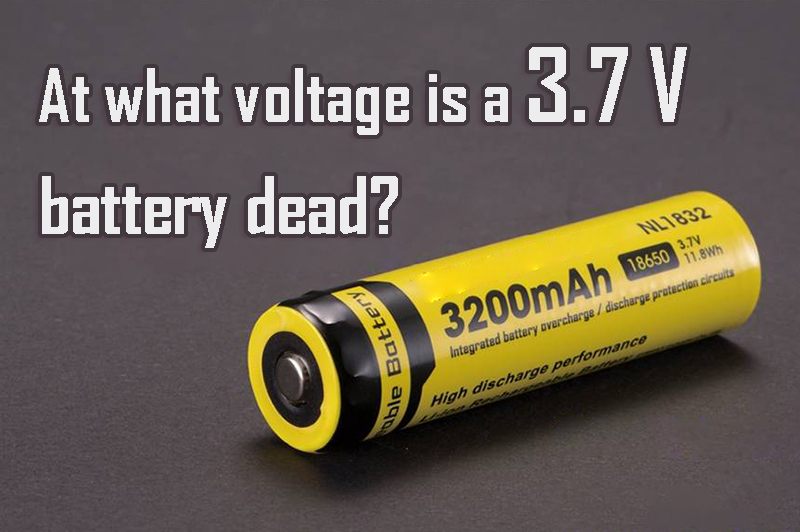
It is important to note, however, that some 18650 batteries do not have cut-off circuitry. As such, you should not discharge it beyond 3.0V, otherwise the battery voltage will drop rapidly and may even cause irreversible damage to the battery due to overdischarge. When comparing the 18650 battery 4.2V vs 3.7V, it is logical to conclude that the former is better than the latter. The 18650 battery with 4.2V can support more loads or power a device longer than the 3.7V battery.
6.What voltage should I charge a 3.7 V lithium ion battery?
The recommended 18650 charging voltage is 4.2V. A 3.7V lithium-ion battery should always be charged at 4.2V, which is the correct and safe full-charge 18650 voltage. In addition, it should be noted that a 3.7V lithium-ion battery should be charged using a 4.2V constant voltage charging mode. Otherwise, when the charging voltage exceeds 4.2v, it is easy to cause the battery to be overcharged, which may damage the battery.
7.Can I charge a 3.7 V battery with a 4.2 V charger?Matching charger with 18650 battery voltage
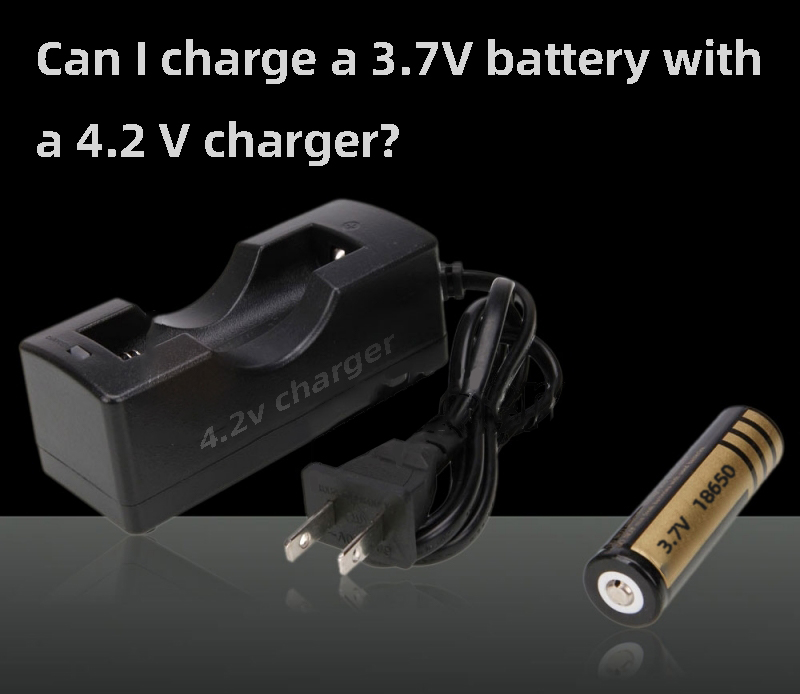
Yes, you can charge a 3.7V lithium-ion battery with a 4.2V charger because its cutoff 18650 battery voltage is exactly 4.2V. When using the charger to charge the battery, the output voltage of the charger should match (ie equal) the maximum voltage of the battery. If the output voltage of the charger is higher than the maximum voltage of the battery, the battery may be damaged. On the other hand, if the output voltage of the charger is lower than the voltage of the battery, the battery cannot be fully charged. The charge cut-off voltage of a 3.7V battery is exactly 4.2 V. Therefore, it is possible to use a 4.2V charger as a 3.7V battery charger, but using a 5V charger to charge a 3.7V battery will cause the battery to overcharge.
8.Can I use a 3.7 V battery instead of 4.2 V?Understanding 18650 battery voltage compatibility
Yes. A 3.7V lithium-ion battery’s nominal voltage is 3.7V, and its full-charge voltage is 4.2V. In the case of the same size and capacity, a battery with nominal voltage of 3.7V is the same as a battery with a limit voltage of 4.2V, so the former can be used instead of the latter.
9.Conclusion
Differentiating between the 18650 battery voltage 4.2V vs 3.7V can be a challenging process because of the similarities between the two batteries. Not all 18650 batteries have the same voltage - they range from 2.5V to 4.2V. However, when you compare your 18650 battery 4.2V vs 3.7V, the the former can provide longer durations. When charging your 3.7V lithium ion battery, do not use a charger that has more than 4.2V. When comparing the 18650 battery 4.2V vs 3.7V, it is logical to conclude that the former is better than the latter because the 18650 battery has a higher output.
Related article: 4680 battery vs 18650, top 10 18650 lithium battery companies